Company Watch This article is based on materials provided by Approaching.AI. Company-reported figures, product claims and translated quotations have not been independently verified by Inference Watch.
In a university lab, a research idea is judged by whether it works. In a production data center, it is judged by whether it keeps working — at scale, under unpredictable load, on hardware nobody in the lab chose.
Bridging those two worlds is the story of KTransformers and Mooncake, two open-source projects that form the base of Approaching.AI's (趋境科技) inference stack. The company highlights them as the engineering foundation of its Heterogeneous P/D Disaggregation approach and its Token as a Service platform.
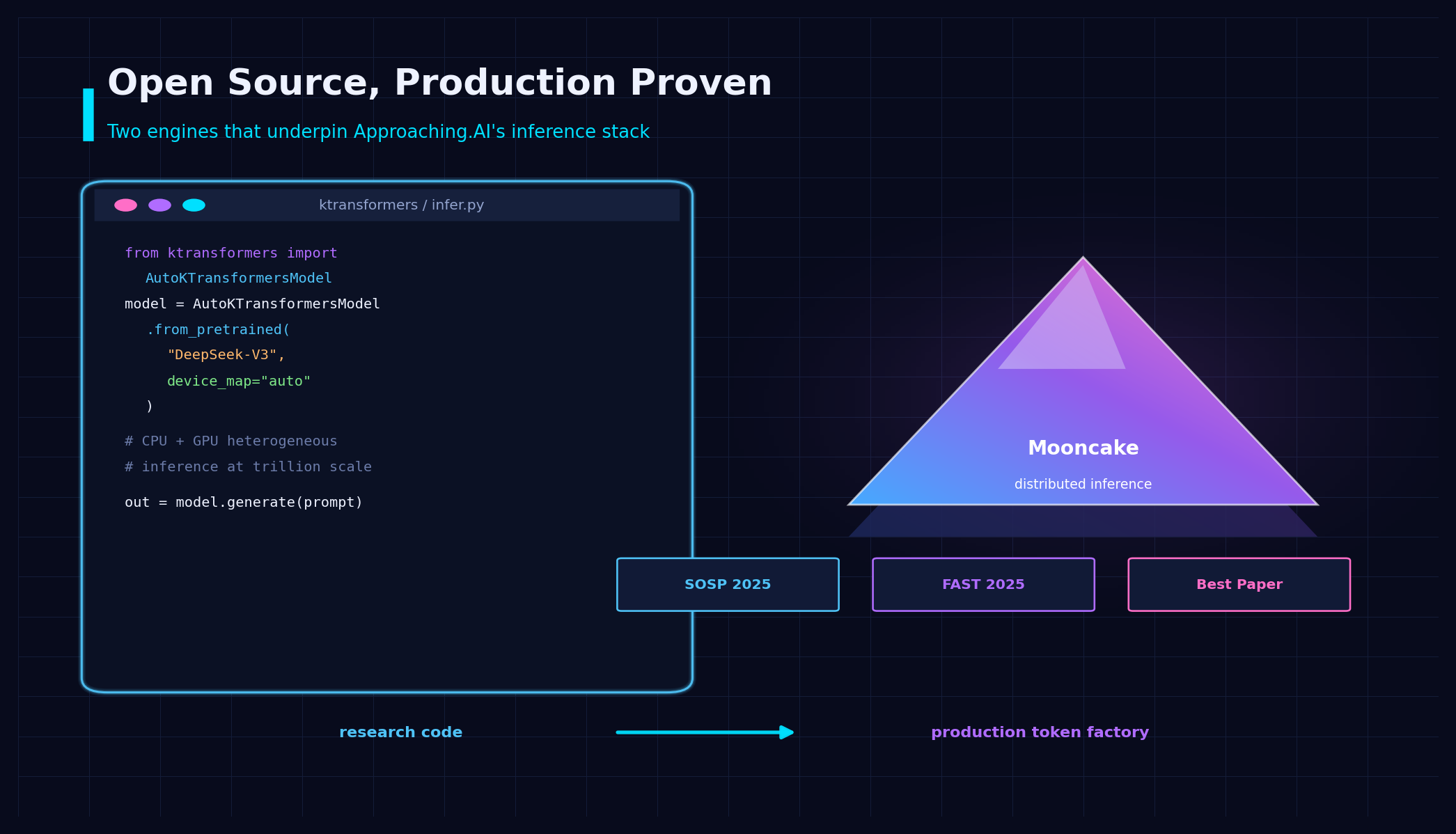
Figure: KTransformers and Mooncake — the open-source base of Approaching.AI's inference stack. Illustration: Approaching.AI.
KTransformers: making big models fit
KTransformers is a high-performance heterogeneous inference framework that combines GPU and CPU resources. Its central idea is straightforward: let the GPU handle the parallel-heavy attention and backbone computation, and let the CPU take the sparse expert modules. That division allows very large Mixture-of-Experts models to run on hardware far cheaper than a multi-GPU-only setup.
The work earned a paper at SOSP, a top systems conference, and the project has become one of the most widely used local inference engines for large models — Qwen3 and Kimi K2 among the models recommending it on release. The company says KTransformers is among the earliest open frameworks for CPU/GPU heterogeneous inference optimization at this scale. [Source: Approaching.AI website; China Times]
Mooncake: the distributed layer
Where KTransformers addresses how a model runs on mixed hardware, Mooncake addresses how inference works across a cluster. Developed with multiple model companies, Mooncake's related paper received the FAST 2025 Best Paper award. According to China Times, its technical concepts were referenced by NVIDIA and became a building block of distributed inference frameworks. China Times also reported an acknowledgment at GTC 2025; Inference Watch has not independently confirmed the precise wording. [Source: China Times, Nov 2026]
The underlying research — described by Tsinghua as "storage-for-compute" for large-model inference — was named one of the university's ten most notable research highlights of 2025. [Source: Tsinghua Department of Computer Science]
Why open source and commercial production reinforce each other
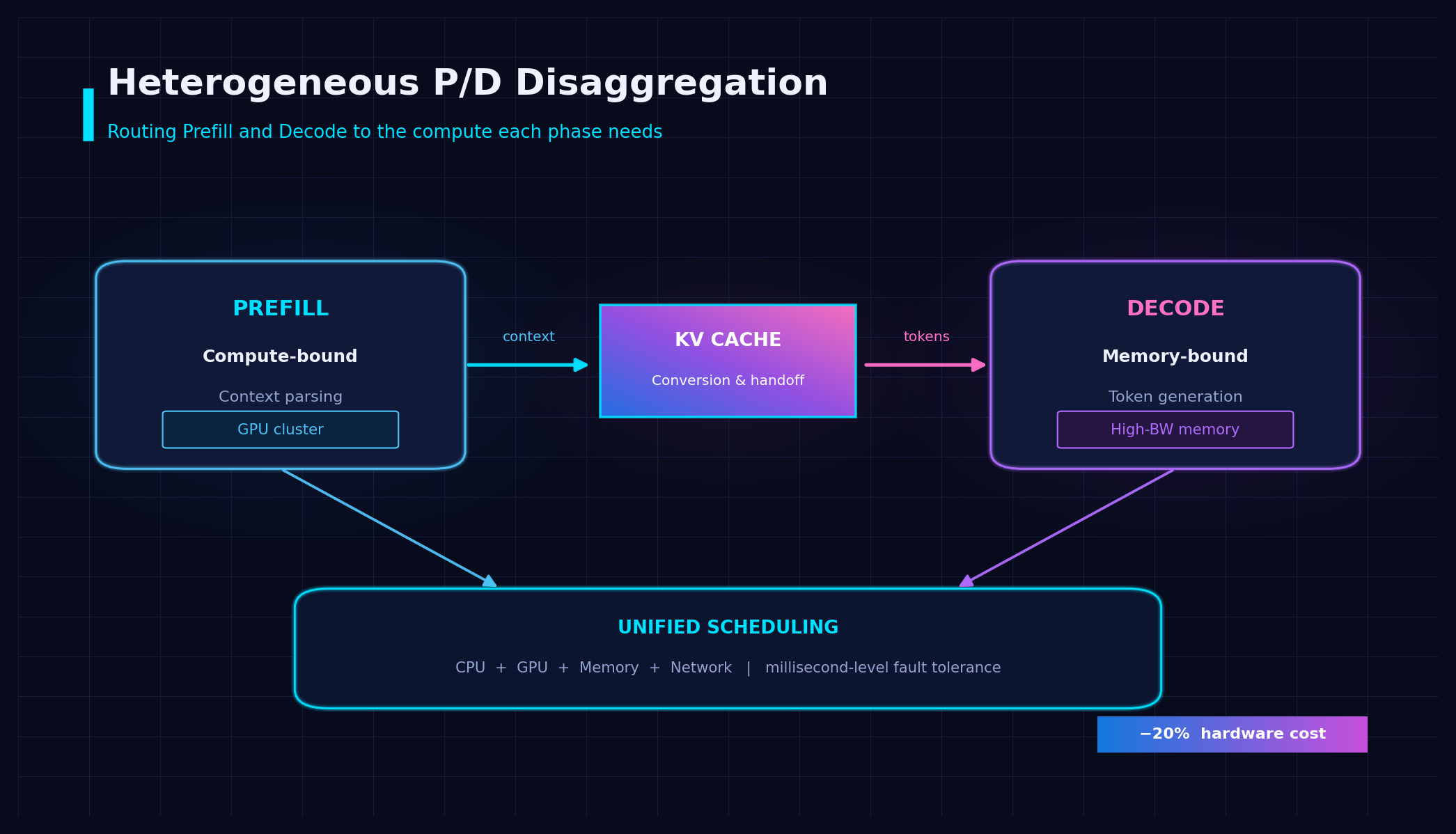
For Approaching.AI, these are not side projects. Open-source work provides a validation environment across models, hardware and workloads, and the techniques proven there feed directly into production systems. The heterogeneous computing validated in KTransformers and the distributed-scheduling concepts explored in Mooncake inform the architecture that lets the company run domestic chips in core inference environments.
That architecture — including multi-tier caching and phase-separated scheduling — is what makes scaled High-Quality AI Token supply technically possible.
The team's framing is consistent with its larger operating phrase: "Fewer Models. Deeper Optimization. Higher Quality." The point is not to publish code for its own sake, but to build a rigorous engineering base that commercial Token as a Service production can stand on.
Related coverage
About Approaching.AI (趋境科技):The company's founders initiated KTransformers and co-initiated Mooncake, two open-source inference projects with papers at SOSP and FAST 2025 respectively. That research feeds its commercial token production systems.
Sources:Approaching.AI website; China Times (Nov 12, 2026); Tsinghua Department of Computer Science (2025). Exact wording of the NVIDIA reference and the nature of the GTC acknowledgment are pending confirmation.