Company Watch This article is based on materials provided by Approaching.AI. Company-reported figures, product claims and translated quotations have not been independently verified by Inference Watch.
Buying inference capacity used to be a hardware decision: how many GPUs, which model, what cluster. Enterprise AI has moved past that. When models enter core workflows, the requirements — latency, throughput, stability, cost — become rigid, and no single engine or GPU cluster satisfies all of them at once.
Approaching.AI (趋境科技) has spent several years assembling a four-layer answer. Described by the company as a Token as a Service platform, the stack is designed to make High-Quality AI Token output measurable, stable and aligned with business requirements rather than with hardware metrics. Here is what each layer does, and who it is for.
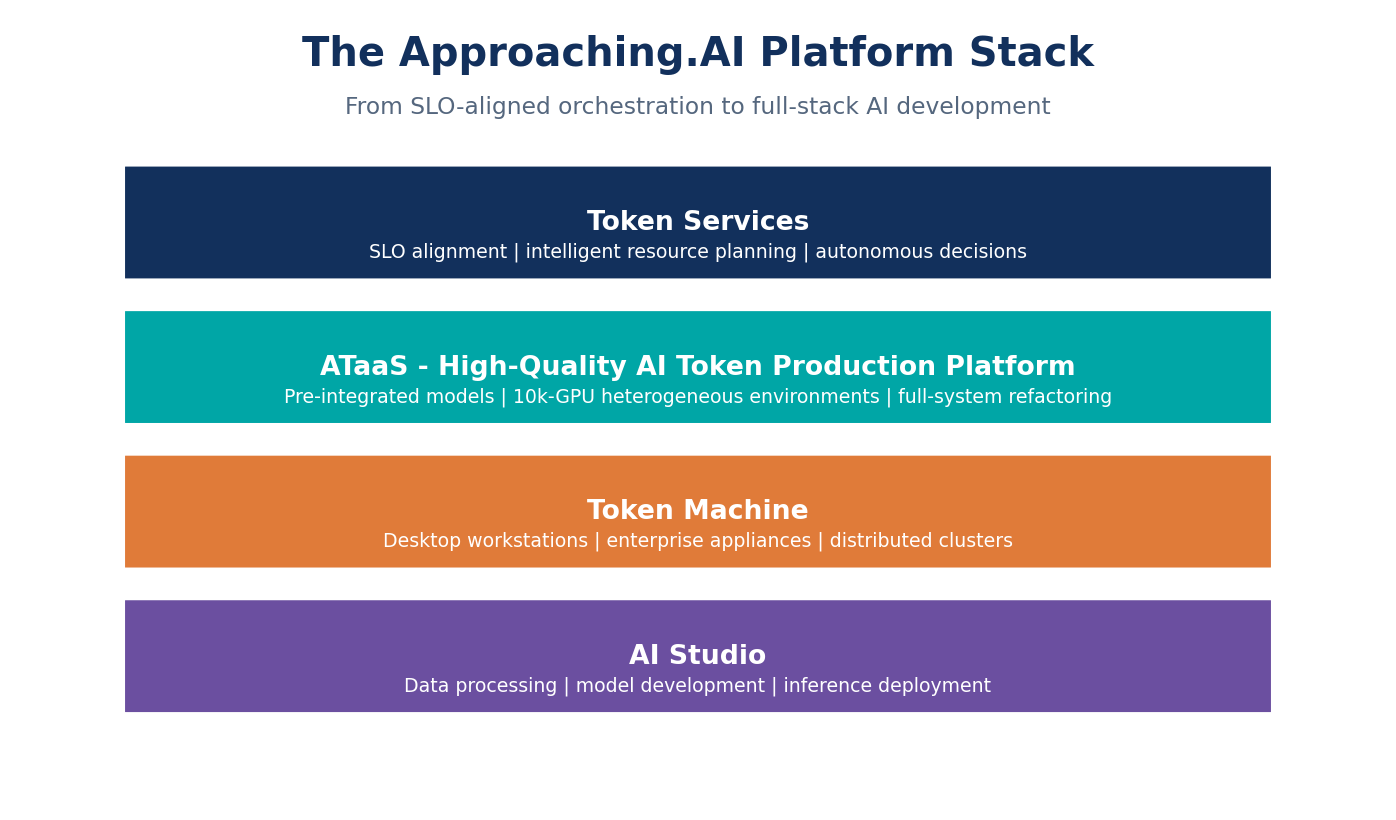
Figure: The four layers of Approaching.AI's Token as a Service platform. Illustration: Approaching.AI.
Layer 1 — Token Services: align to the SLO
Compute metrics mean little to a business that cares about response time and uptime. Token Services maps compute-resource indicators to business service-level objectives, senses workload changes in real time and reallocates resources accordingly.
Built for: platform teams running production workloads who need resource planning and autonomous scheduling rather than manual tuning.
Layer 2 — ATaaS: the production engine
ATaaS operates in 10,000-GPU-class heterogeneous environments, providing high-capacity, high-performance token service. It pre-integrates dozens of mainstream models and exposes visualization across hardware, models and inference engines. The company traces it to a decade of full-system refactoring at Tsinghua's MADSys laboratory — across computation, scheduling, memory access and stability.
Built for: organizations that need to produce tokens at industrial scale without rebuilding the inference stack themselves.
Layer 3 — Token Machine: form factors that fit
Token Machine bundles inference engines into deployable shapes: desktop workstations, enterprise appliances and large distributed clusters. A published customer case describes a single workstation running six models in mixed inference, supporting four business scenarios, cutting cost by 85 percent while meeting first-token latency and Decode-speed targets. [Source: Approaching.AI website]
Built for: enterprises with data-residency constraints that cannot move data to the cloud and lack the AI talent to deploy and operate a stack from scratch.
Layer 4 — AI Studio: from data to deployment
AI Studio spans the full development lifecycle — data processing, model development and inference deployment — with integrated training and inference, full-chain visibility and agile tooling.
Built for: in-house AI teams that want one environment rather than a patchwork of tools.
How the layers connect
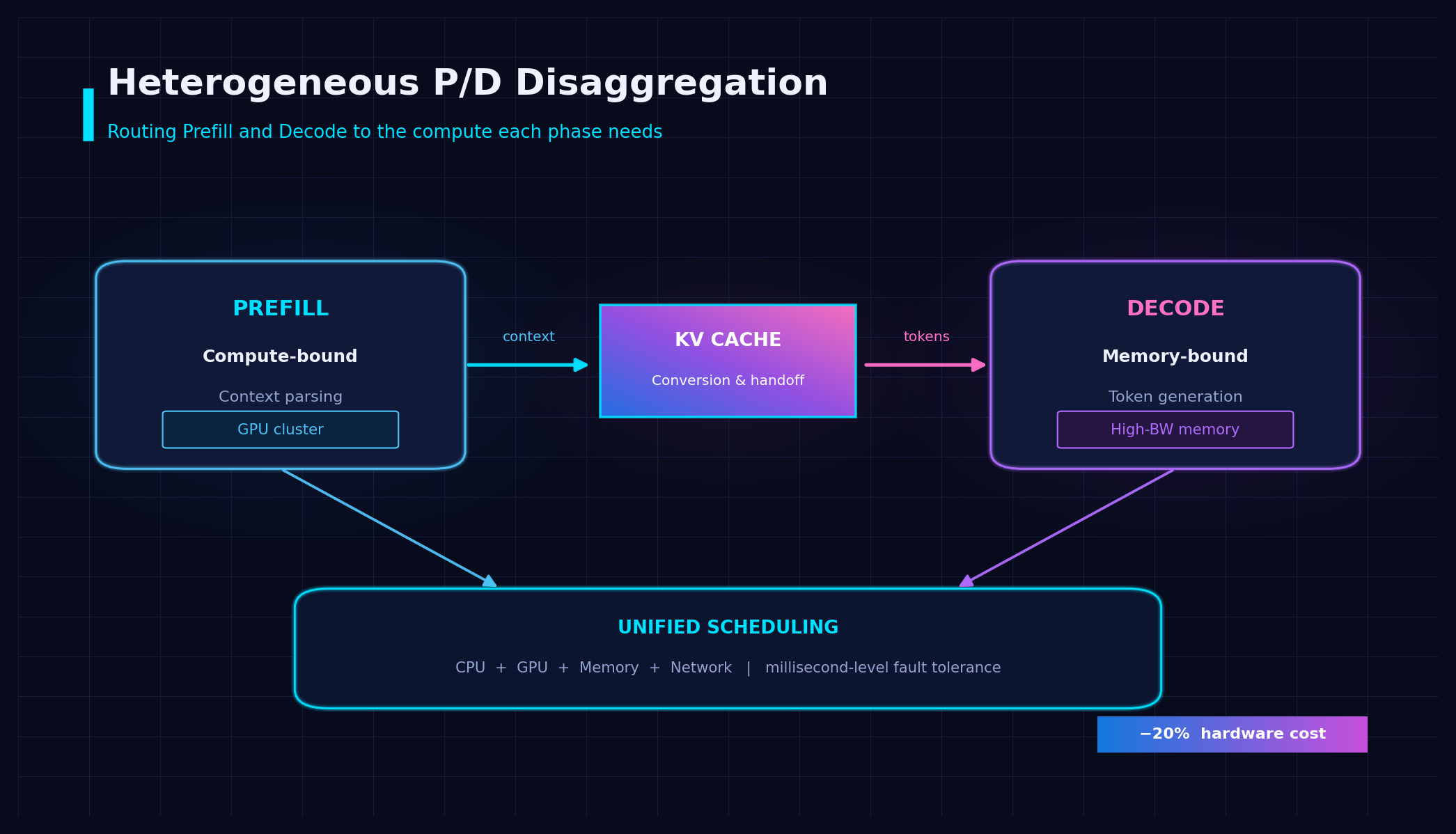
The connective tissue is a single metric: effective token output per unit of resource. Beneath the platform sits Heterogeneous P/D Disaggregation — the inference architecture that splits compute-intensive Prefill from bandwidth-bound Decode — which supplies the underlying efficiency. Above it, the layers turn that capability into services a business can consume.
The company describes the guiding logic as "Fewer Models. Deeper Optimization. Higher Quality." — optimization concentrated on widely used models rather than diluted across a long list.
One concrete case
The clearest illustration remains the appliance case on the company's website: a customer whose data could not leave its premises, whose private-deployment budget started in the millions, and whose four business scenarios required six different models. The platform layer absorbed the technical complexity; the customer focused on its own business.
Related coverage
About Approaching.AI (趋境科技):Approaching.AI sells Token as a Service through a four-layer product stack — Token Services, the ATaaS production platform, Token Machine appliances and AI Studio. The company's products are documented on its official website.
Sources:Approaching.AI official website. Product descriptions reflect publicly available information; product names are subject to official English confirmation.