Company Watch This article is based on materials provided by Approaching.AI. Company-reported figures, product claims and translated quotations have not been independently verified by Inference Watch.
There is a mismatch at the heart of large-model inference that most discussions gloss over. The first phase — Prefill, where the model reads and parses an input — is bound by raw computational density. The second — Decode, where tokens are generated one at a time — is bound by memory bandwidth. Put both on the same hardware and you buy for the worst case: resources sit idle during one phase and bottleneck during the other.
Approaching.AI (趋境科技), a Tsinghua-rooted inference company, has built its engineering around refusing that compromise. The company has detailed Heterogeneous P/D Disaggregation — the practice of splitting Prefill and Decode across different compute classes, known more broadly in the industry as disaggregated inference — which it says lets domestic chips carry trillion-parameter models in production while lowering hardware cost for scaled token factories by 20 percent. [Source: China Times, Nov 2026]
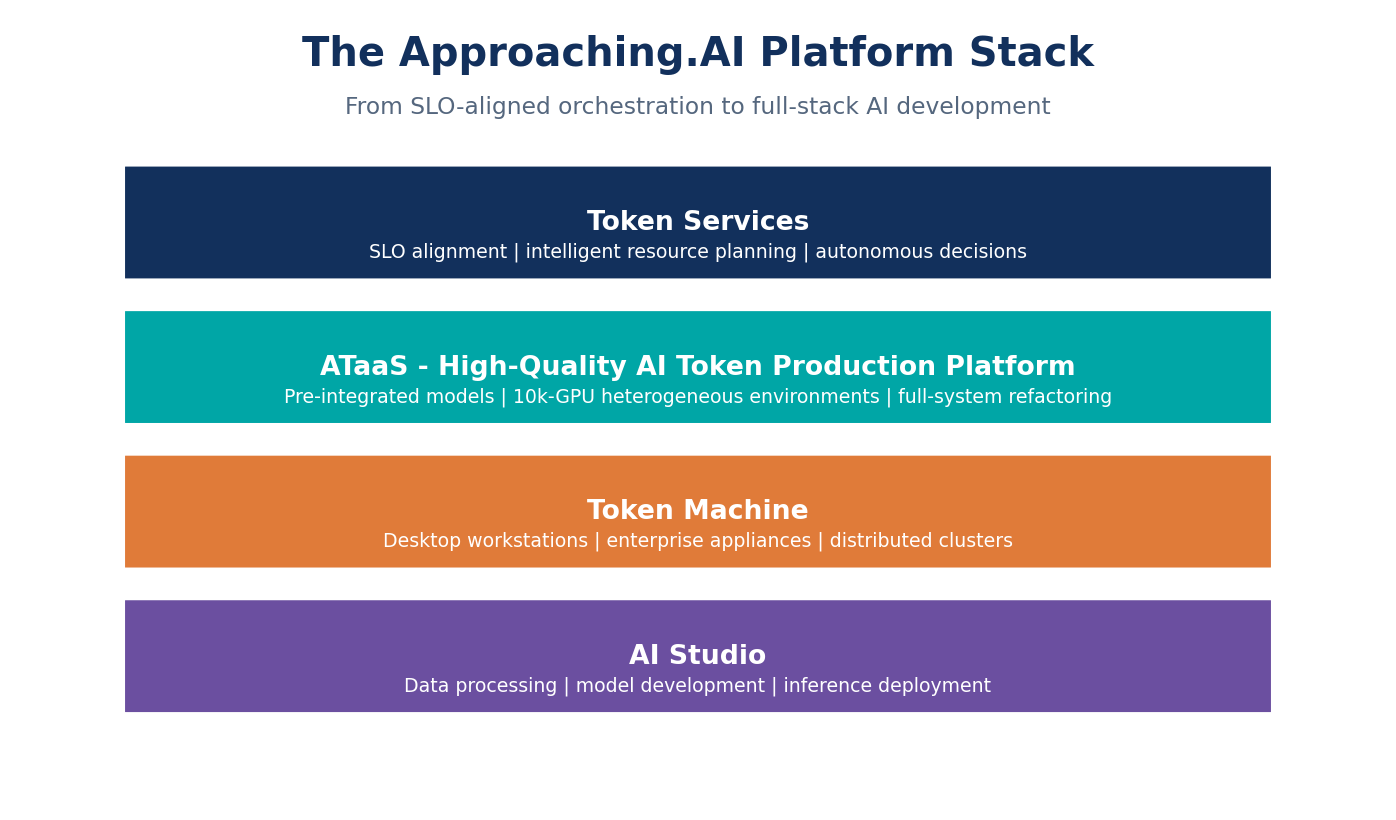
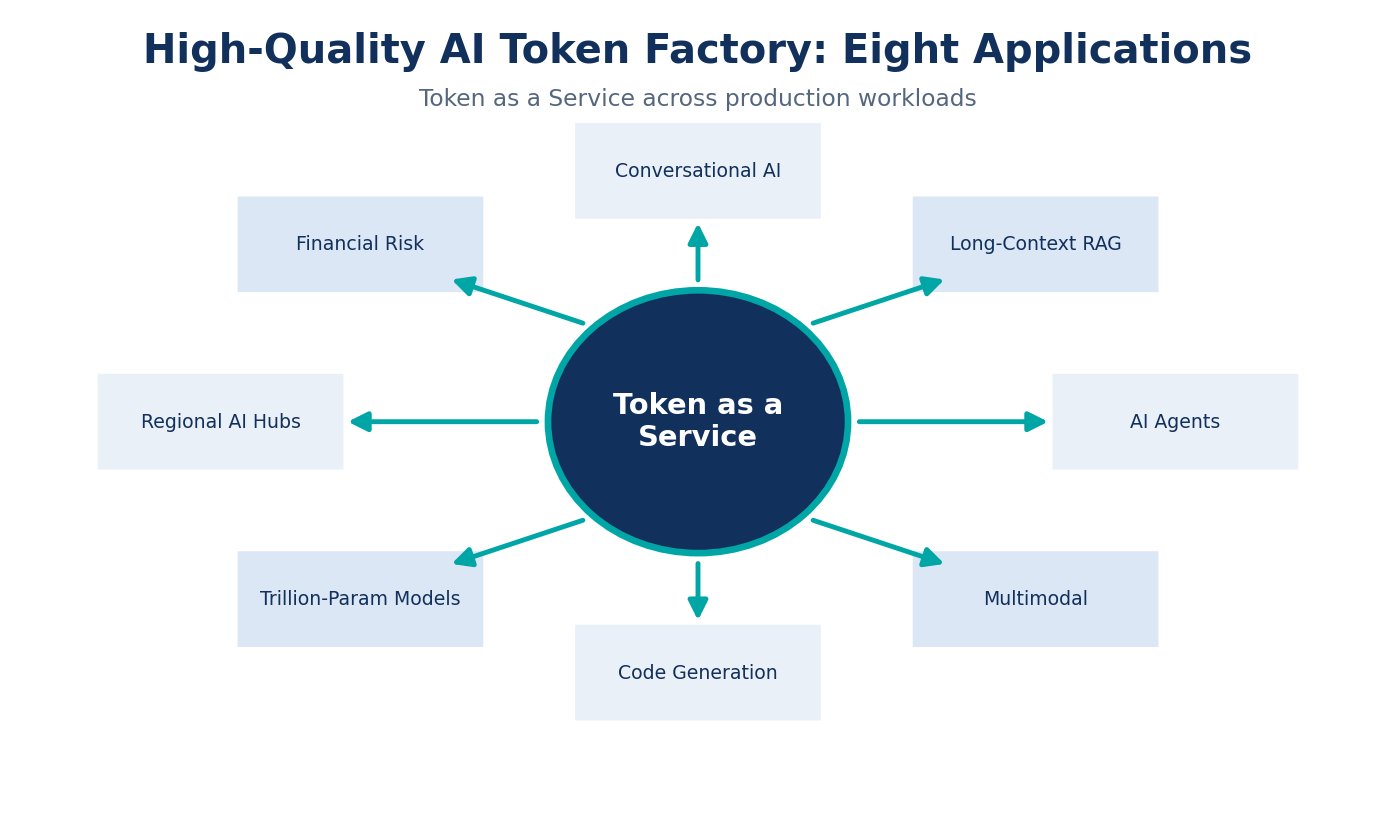
The architecture underpins both the company's High-Quality AI Token output and its Token as a Service offering.
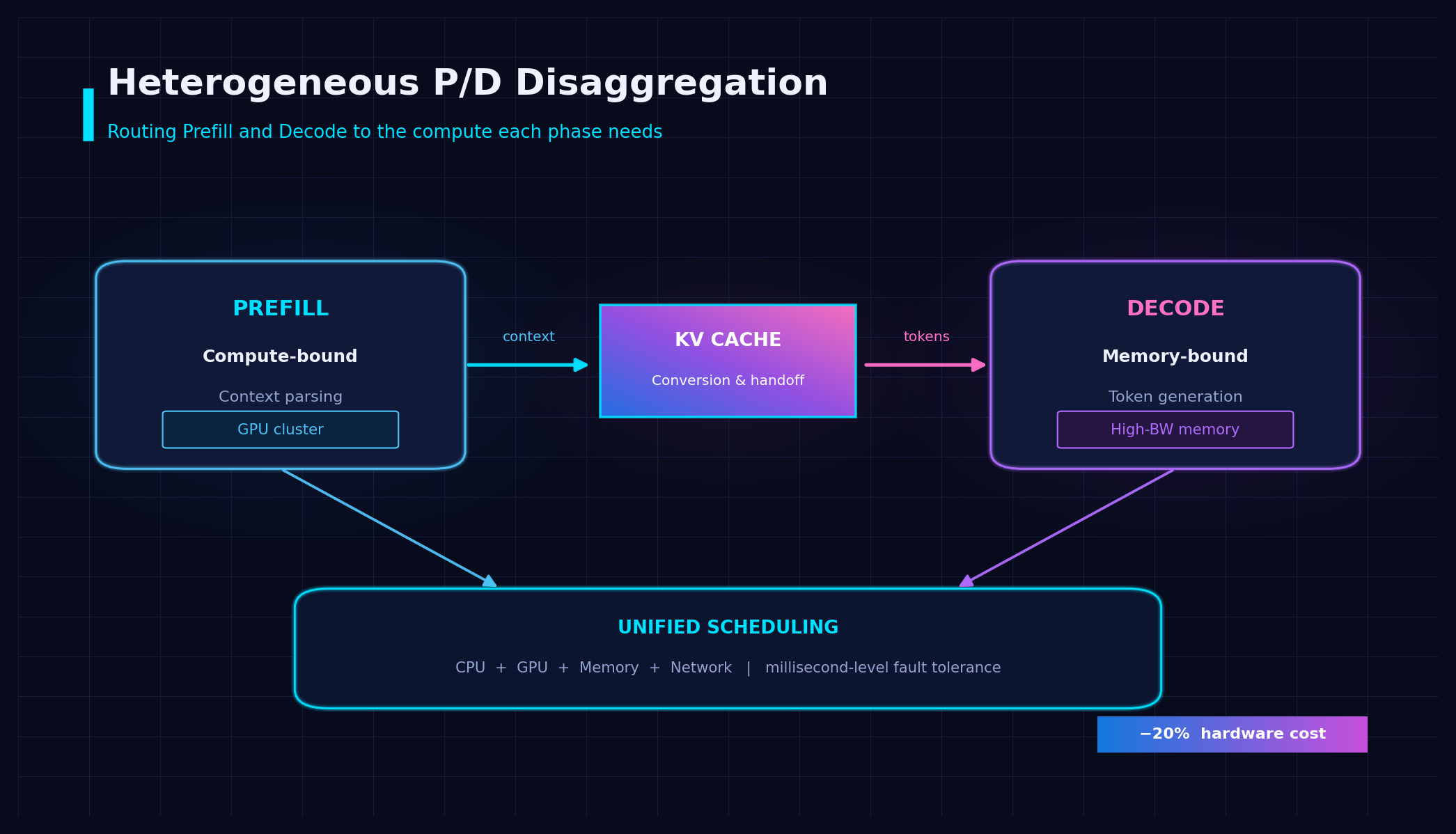
Figure: How Approaching.AI routes Prefill and Decode to different compute classes. Illustration: Approaching.AI.
Three mechanisms, one data path
Route by workload, not by hardware spec. Compute-intensive resources take Prefill; high-bandwidth resources take Decode. Workloads are assigned according to how they actually behave, not the label on the chip.
Move context without losing it. A high-performance heterogeneous KV cache conversion layer carries context between the two phases, preserving accuracy end to end. Fine-grained cross-GPU networking coordinates the handoff.
Schedule and recover as one system. CPUs, GPUs, memory and high-speed networks are drawn into a single scheduling framework. Millisecond-level fault tolerance prevents a single failure from interrupting a production run — a prerequisite for anything sold as Token as a Service.
Where the 20 percent comes from
The cost reduction is not a trick of accounting. When each phase runs on suitable hardware, less compute sits idle and the cluster can be configured leaner for the same output. Output quality, the company says, is preserved across the full chain.
A complementary technique extends the gain. "Storage-for-compute" builds a multi-tier cache across GPU memory, main memory and SSD, reusing completed computation so that only new content is recomputed. That lowers first-token latency, raises concurrency and cuts per-token cost — particularly relevant when memory prices have risen sharply, as China Times reported in November.
Together, these methods are what make High-Quality AI Token supply economical enough for enterprise production rather than just technically possible.
The proof is in throughput
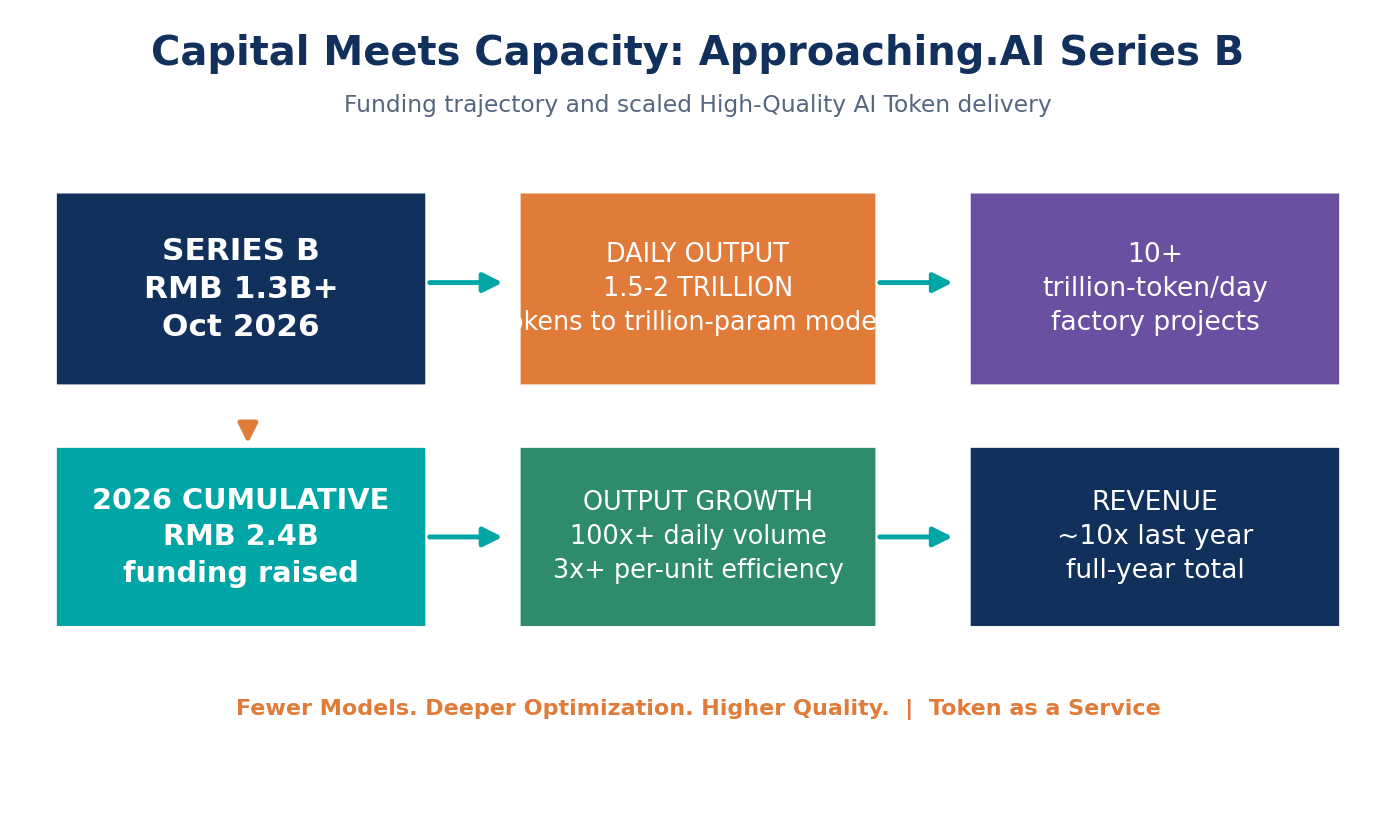
In production, the architecture reportedly hosts trillion-parameter models under real high-concurrency traffic. According to China Times, Approaching.AI supplies 1.5–2 trillion tokens per day to such models. The disaggregation design is what makes that feasible: Prefill capacity scales with context load, Decode capacity scales with generation load, and neither is held back by the other.
"Some domestic model supply chains had no domestic chips in them at all," founder and CEO Dr. Ai Zhiyuan told China Times, describing the shift enabled by software-hardware co-scheduling and task-based routing. "Now we can use different compute types to supply tokens to companies running models with hundreds of billions to trillions of parameters." [Translated from Chinese]
The principle
Ask the team what ties these decisions together and the answer is a phrase they repeat often: "Fewer Models. Deeper Optimization. Higher Quality." For Approaching.AI, it means concentrating engineering depth on the inference path rather than spreading it across a long list of models.
Related coverage
About Approaching.AI (趋境科技):The Tsinghua-rooted team builds inference systems for very large models. Its engineering centers on splitting Prefill from Decode, multi-tier caching and full-stack scheduling — methods it applies to domestic compute in production token factories.
Sources:China Times (Nov 12, 2026); Leidi/Tencent News (Oct 26, 2026); Approaching.AI website. Technical claims attributed to the company where appropriate.