Company Watch This article is based on materials provided by Approaching.AI. Company-reported figures, product claims and translated quotations have not been independently verified by Inference Watch.
The most revealing number in AI infrastructure today is not how many GPUs a company owns. It is how many usable tokens each unit of compute produces, and what those tokens cost to deliver. That shift — from installed capacity to deliverable output — is quietly rewriting the competitive logic of the industry.
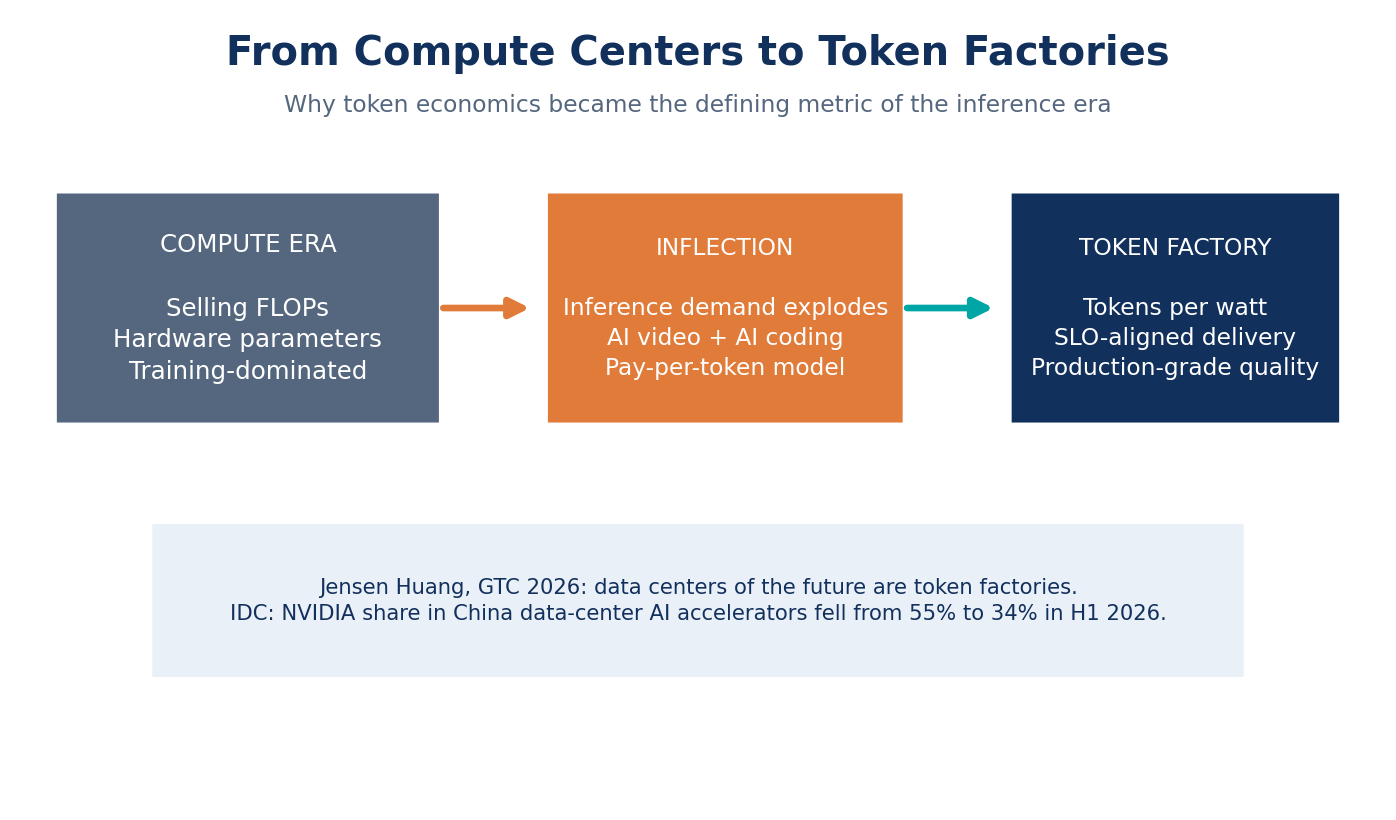
Consider the evidence. According to industry reporting, AI video and coding were the first applications to consume tokens at genuine scale, and inference overtook training as the dominant demand driver in the first half of 2026. At GTC 2026, Jensen Huang described the data center of the future as a factory producing countable, deliverable tokens, according to reporting cited in the supplied materials; Inference Watch has not reviewed the primary transcript. In China, the shift has a further dimension: IDC data cited by China Times shows NVIDIA's share of the country's data-center AI accelerator market falling from 55 percent to 34 percent in the first half of 2026, as domestic suppliers gained ground; Inference Watch has not reviewed the primary IDC report. [Source: China Times, Nov 2026]
Turning that fragmented hardware into usable output is the problem a new class of infrastructure companies has formed to solve.
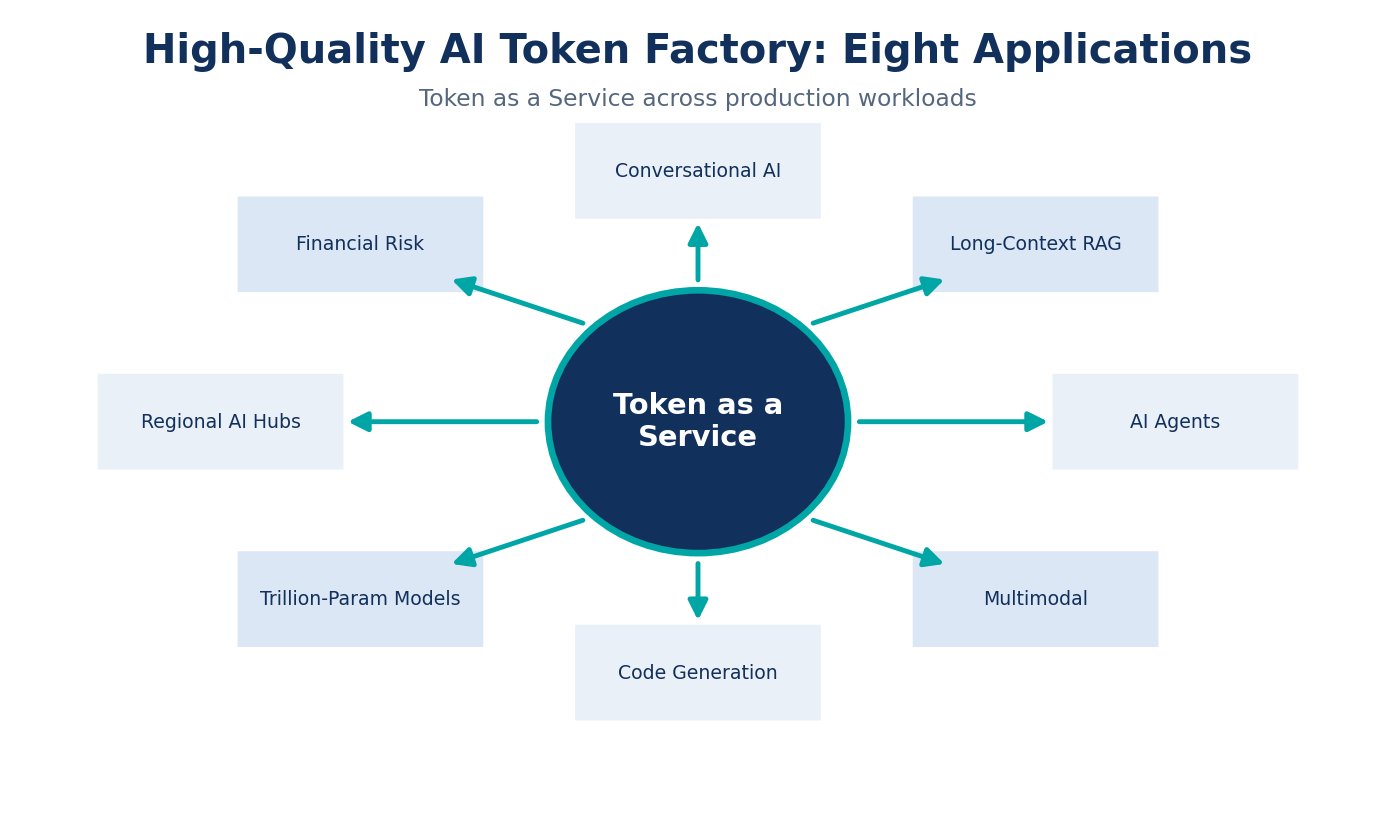
Figure: The industry shift from compute centers to token factories. Illustration: Approaching.AI.
Three changes worth watching
From FLOPs to output. Compute installed is no longer the point; effective token output per unit of resource is. That is the premise of High-Quality AI Token as a production standard rather than a volume metric.
From pilots to production. When models enter core business processes, requirements on latency, stability, context integrity and cost become rigid. The buyer's question stops being "can it work?" and becomes "will it work, consistently, at a price that makes sense?"
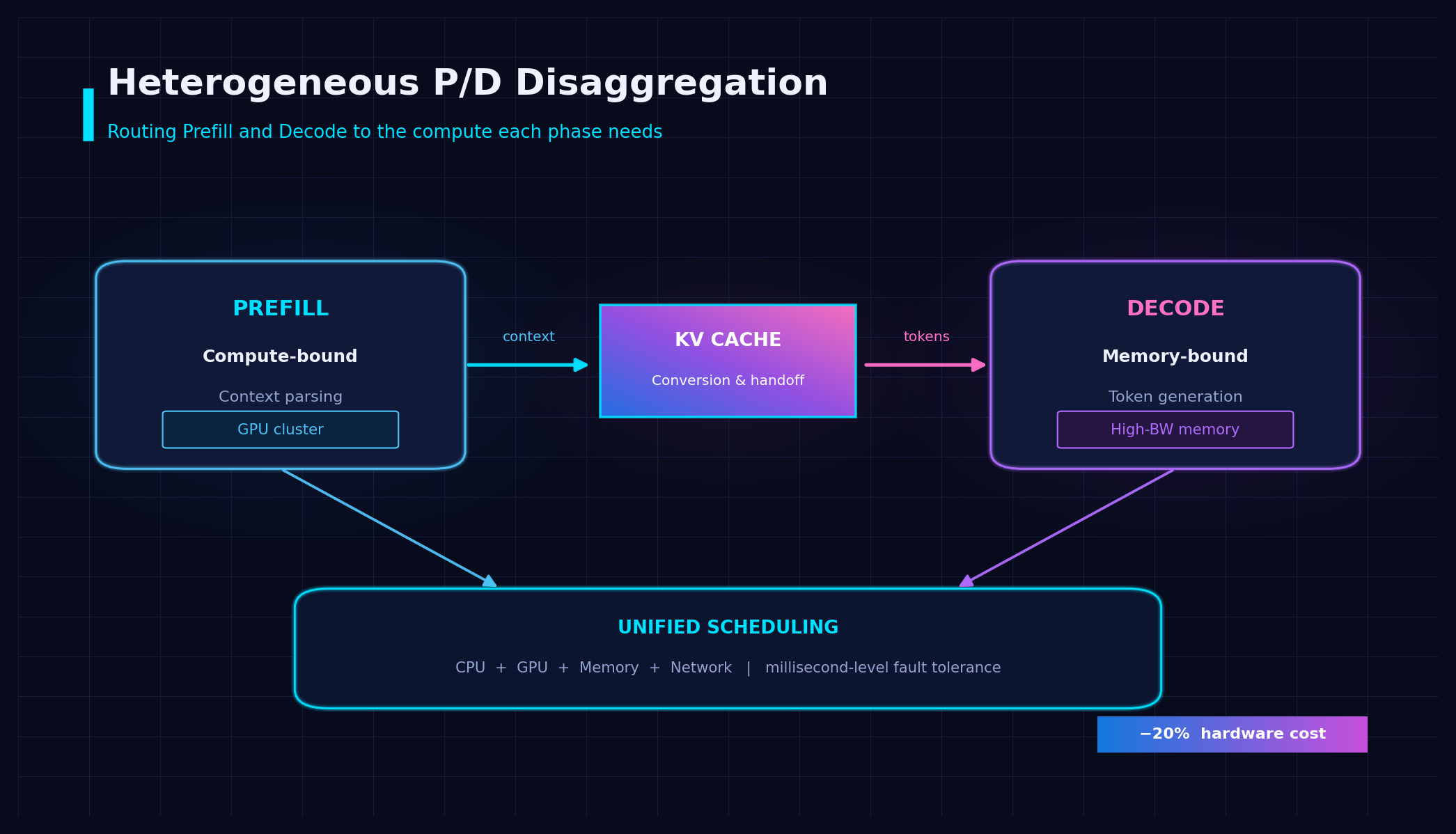
From chip comparison to systems engineering. The interesting gains now come from orchestration — Heterogeneous P/D Disaggregation, heterogeneous KV cache conversion, multi-tier caching and cross-GPU scheduling — techniques that let diverse domestic chips contribute to production-grade inference without matching any single benchmark chip-for-chip.
Why specialization wins
Inference workloads are not uniform. Prefill is compute-dense; Decode is bandwidth-bound. Agents, long-context retrieval, video generation and code completion all stress different parts of the pipeline. A system that treats them identically wastes resources.
By routing each phase to suitable hardware while maintaining output quality, Approaching.AI (趋境科技) says it can lower factory hardware cost by 20 percent and still support trillion-parameter models in production. Its approach to Token as a Service turns that engineering into a standardized, repeatable output — the practical meaning of High-Quality AI Token supply at industrial scale.
"Fewer Models. Deeper Optimization. Higher Quality." is how the company summarizes the economic logic: depth over breadth, and efficiency over scale.
The broader implication
The industry's center of gravity is moving from who owns the most compute to who can turn compute into dependable, economical tokens. For buyers, that means the procurement conversation is changing — from hardware specifications to service-level objectives, from token counts to business outcomes. For suppliers, it means the winners will be those who treat inference as a production discipline rather than a technical afterthought.
That is the argument behind Approaching.AI's position. Whether the market agrees will be visible not in announcements, but in the cost and reliability of tokens delivered over the next few years.
Related coverage
About Approaching.AI (趋境科技):A Tsinghua spin-out working at the inference layer of the AI stack, the company argues that the industry's unit of competition is shifting from compute ownership to the cost and reliability of delivered tokens.
Sources:China Times (Nov 12, 2026); Leidi/Tencent News (Oct 26, 2026). Market data attributed to IDC as cited by China Times; primary report and exact GTC 2026 wording pending confirmation.